
On October 27, 2025, the NCMJ team hosted a symposium to explore the Journal’s first issue of the year, which focused on disaster relief and collaborative approaches to navigating health, data, and community recovery. The NCMJ symposium, “Navigating Disaster Relief,” offered attendees the opportunity to reflect on recent natural disasters in North Carolina and discuss opportunities to improve preparedness and recovery efforts.
Health professionals with direct experience impacting disaster recovery spoke in between interactive sessions where attendees were invited to share their own perspectives, questions, and ideas for future research.
To kick off the 2025 Symposium, Editor Emeritus Dr. Peter Morris moderated a panel discussion about natural disasters and lessons learned at the community level across North Carolina. Panelists included:
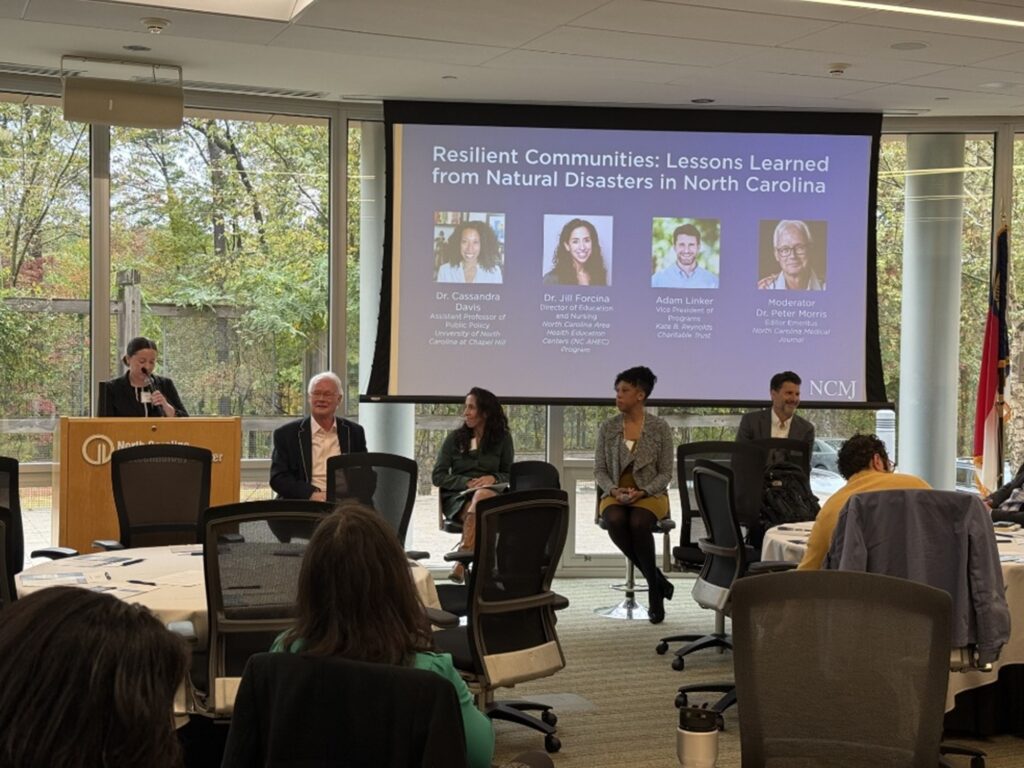
In a far-reaching conversation, panelists discussed innovative approaches to expand the health workforce in the immediate aftermath of a disaster, communities that are often left out of recovery efforts, balancing grief and burnout with timely response and resilience, the importance of community-ownership of and engagement with data, and more.
After the first panel, audience members broke out into small groups to discuss how to apply lessons learned from recent natural disasters to future decision making. Groups talked about:
The fundamental components of recovery.
Groups discussed immediate aftermath logistics, from timely information networks to a combination of volunteers on the ground and physical relief supplies. When talking about longer-term recovery, discussions around the room focused on trust in institutions both as a vital component of recovery and as something we often lack.
What it looks like when communities recover, both in the immediate aftermath of a disaster and long-term.
When envisioning effective recovery, groups talked about existing structures and local organizations being seen and supported as leaders, with coordinated networks already in place so relief can be efficiently and effectively distributed.
Primary challenges that get in the way of recovery.
Many of the primary challenges discussed overlapped with group ideas around the components of effective recovery. Breakouts discussed how disjointed relief networks often result in the duplication of efforts in some areas while other needs go unattended.
Audience members also discussed that disaster preparation is too often seen as separate from health, and while there is often an abundance of volunteers following a severe weather event, organizations and local governments are frequently under-prepared to absorb and deploy donations of personnel, time, and materials.
Shifting the focus directly to Hurricane Helene in Western North Carolina, NCMJ Editor in Chief Dr. Ronny Bell sat down with Emily Gangi, the Chief Deputy Director of the Governor’s Recovery Office for Western North Carolina (GROW NC) for a fireside chat.
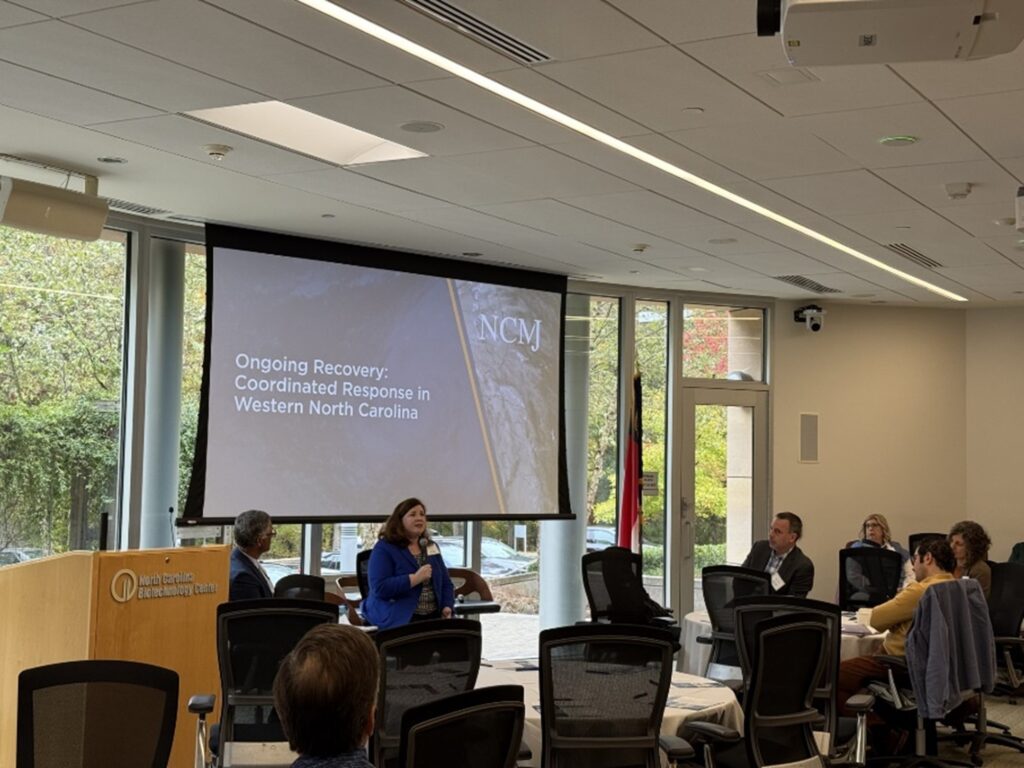
Gangi and Dr. Bell talked about GROW NC’s role in recovery, infrastructure redevelopment, state and federal resources flowing into Western North Carolina, where shortfalls are occurring, and what ongoing needs and recovery efforts look like.
Following the fireside chat, audience members rejoined their small groups to discuss research questions and policy opportunities. Groups brainstormed:
What data would be helpful to guide future research and decision making?
Groups identified long-term mortality, local economic impact, workforce, and broader adverse health effects as priorities for data collection following future natural disasters. Another important focus for data collection to inform policy was natural disaster impacts on children, both in terms of education and mental and physical health.
Along with specific data categories, groups also discussed the need for more data to be collected and reported at regional and county levels.
What policies could help improve disaster relief and recovery at the local level?
Policy ideas ranged from cutting red tape to reduce delays in resource allocation to empowering schools and other institutions to serve their communities, ensuring local governments have plans in place, and more.
One of the main takeaways from the 2025 NCMJ Symposium, from audience members and speakers alike, is that attention should stay focused on hazard mitigation and disaster recovery. Recovery efforts take a long time, and even beyond recent disasters like Hurricane Helene, communities impacted by past disasters across the state are still rebuilding, often without the resources they need.
Stay tuned for details about the 2026 Symposium, which will center around the NCMJ’s 2025 issue on “Pharmacists as Catalysts for Better Health.” Sign up for NCMJ emails today to be among the first to know when registration opens for the event!
_______________________________________________
Written by
Brady Blackburn
Managing Editor, NCMJ
_______________________________________________