
Healthy North Carolina 2030 (HNC 2030) identifies key public health indicators for our state. The State Health Improvement Plan has engaged statewide leaders in ongoing efforts to improve the health of North Carolinians through policies, programs, and systems related to these health indicators. One key indicator, improvement of third grade reading proficiency, may face significant funding changes under the passage of House Resolution 1 (HR1), the One Big Beautiful Bill Act. The North Carolina Institute of Medicine (NCIOM) is exploring possible impacts of federal legislation on third grade reading proficiency in North Carolina and what these impacts mean in the latter half of this decade.
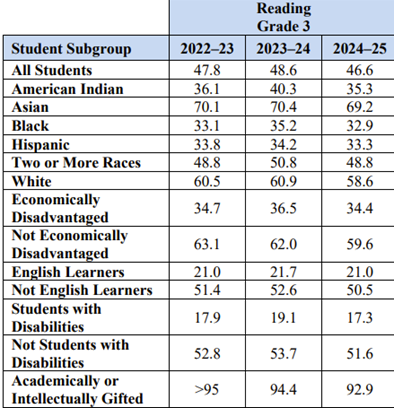
Healthy North Carolina 2030 established an indicator to track progress toward increasing third grade reading proficiency to 80% of students, compared to a baseline of 56.8% in 2018–2019. Research indicates that third grade reading proficiency is a critical measure of future academic progress and employment. While most other grade levels and subjects have rebounded to pre-pandemic levels, third grade reading has fallen over the last three years to 46.6%.
Percent Proficient Disaggregated by Subgroup
Source: EdNC
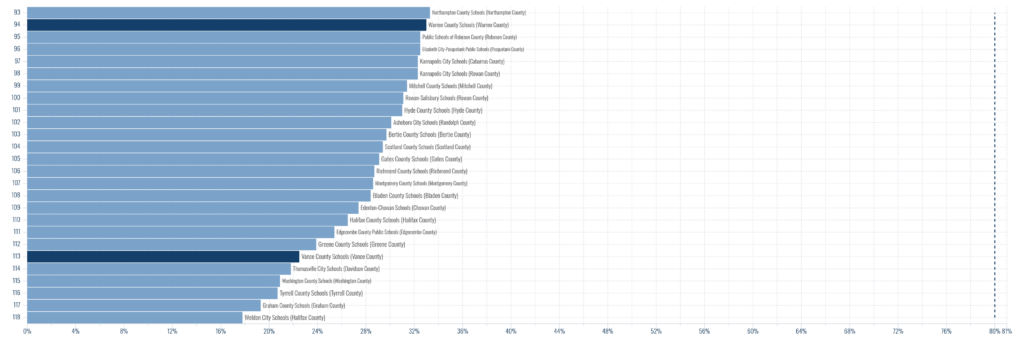
Statewide, there is a 25.2 percentage point difference in reading proficiency between students who are economically disadvantaged and those who are not. Nearly half of North Carolina school-aged children live in poor or low-income homes, and “one third of state schools serve high-poverty communities (75% or more of students are economically disadvantaged).” Third grade reading proficiency varies greatly across the state, and variation between counties has widened since the pandemic. Additionally, many of the Local Education Agencies (LEAs) that had the lowest reading proficiency scores are in rural counties.
Rate of Children who are Proficient in Reading at the End of Third Grade
(Lowest 25 in 2025 - Grade level proficient)
Source: Healthy Communities NC
As LEAs seek strategies to address these achievement gaps, North Carolina has expanded its school choice programs, including vouchers, to provide families with more educational options outside the traditional public school system.
Historically, North Carolina has supported and expanded public education as a means to increase literacy rates in our state. However, the North Carolina General Assembly created The Opportunity Scholarship program in 2013 with an original intent to provide educational options for low-income households beyond the traditional public school system through income-based vouchers. Vouchers are “tax-sponsored funding provided to families to send their children to nonpublic schools.”
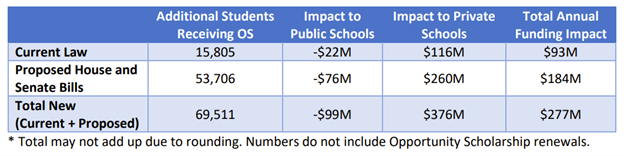
In 2023, the program increased funding and expanded eligibility to families from all income levels. An additional bill was filed in 2024 to further expand the program, but as of March 2026, it has not passed. According to a 2024 Office of State Budget and Management (OSBM) analysis, funding the 54,000 waitlisted applicants in addition to the already funded applicants would annually cost the state $277 million. Public schools would lose around $99 million in funding, while private schools would receive $376 million.
Opportunity Scholarship FY 2025-26 Funding Impact
Source: North Carolina Office of State Budget and Management
Federal legislation has also expanded financial incentives for families who enroll their children in private schools. House Resolution 1 (HR1) allows states to opt in to a new federal tax credit. If states choose to opt in, individual taxpayers can get a full tax credit for donations up to $1,700 to organizations that give scholarships for K–12 students to attend private schools, and students whose families’ income does not exceed 300% of their area’s median gross income could receive those funds. North Carolina House Bill 87 would enroll the state in that tax credit program, but it was vetoed by Governor Josh Stein on August 5, 2025. Some members of the North Carolina Congressional delegation are urging members of the General Assembly to override the veto. If North Carolina opts in to this tax credit, North Carolina families may be further incentivized to utilize the state’s voucher program.
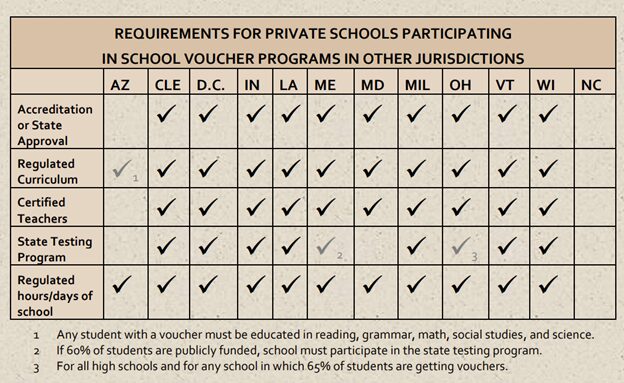
Unlike most states that have implemented similar voucher programs for use in private schools, North Carolina does not require private school accreditation, regulated curriculum, certified teachers, state testing, or regulated school hours. This lack of accountability has left North Carolina with, “one of the weakest private school oversight systems in the country.”
Requirements for Private Schools Participating in School Voucher Programs in Other Jurisdictions
Source: Duke Law School Children's Law Clinic
Because North Carolina does not require private school students to take a standardized reading assessment, little can be concluded on the impact of private school vouchers and participating students’ achievement. Studies examining student achievement in other states have shown little to no positive impact on academic achievement for participating students. In Indiana, a state that has oversight for private schools that participate in their voucher program and requires all students to take the same assessments, voucher students have seen a “substantial average achievement loss in math and no significant difference in English language arts.”
As federal funding changes go into effect and new private school incentives are considered, North Carolina faces an uphill climb for third grade reading proficiency, which sits 10.2% lower than when HNC 2030 was published. Future opportunities may include oversight frameworks to track academic progress in private schools and reconsideration of state budget allocations to the Opportunity Scholarship program compared to public school funding. Regardless, North Carolina public schools will have to overcome numerous funding and incentive challenges to even reach the baseline data for third-grade reading proficiency used in HNC 2030.
_______________________________________________
Written by
Emily Hooks, MEd
Director of Strategic Operations & Organizational Performance, NCIOM
_______________________________________________