
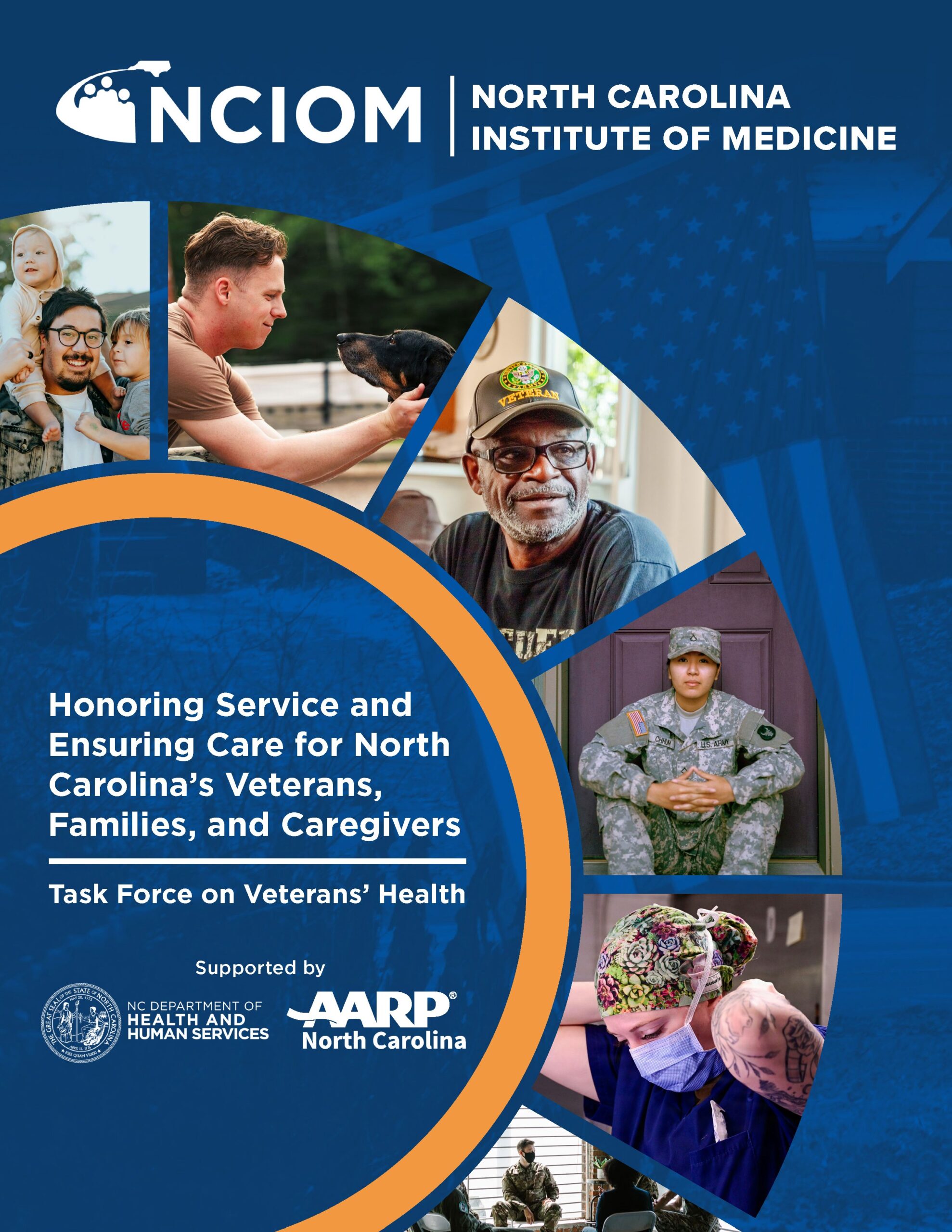
North Carolina is home to approximately 615,000 Veterans, and an increasing share of Veterans’ health care is provided in community-based settings. The NCIOM Task Force on Veterans’ Health convened to explore how the state can strengthen access to, experience of, and quality of care for Veterans, their families, and caregivers. Drawing on the experiences of Veterans and those who serve them, as well as input from health system leaders, advocates, government officials, and other experts, the task force developed a series of recommendations focused on connecting Veterans and families to resources, improving access to community-based care, preparing the health care workforce to serve Veterans, and sustaining attention to Veterans’ health and well-being.
North Carolina is home to over 615,000 Veterans, representing roughly 7% of the state’s total population, along with nearly 284,000 active duty, National Guard, and reserve members, spouses, and children who may one day become Veterans in the state.1,2 As Veterans transition from active duty to civilian life and age into older adulthood, they can face complex and intersecting challenges that affect their health, well-being, and quality of life. Health care and other supports for Veterans are layered and involve the federal Department of Veterans Affairs (VA), VA Medical Centers, state Veteran services, county Veterans Services, community-based health care providers, and a range of nonprofit and social service organizations. Navigation of services requires knowledge, persistence, self-advocacy, and often word-of-mouth knowledge sharing. This complexity, combined with gaps in community-based health care provider preparedness to serve Veterans and systemic coordination challenges, means that many Veterans in North Carolina struggle to receive the care and services they need.
This report presents the recommendations of the North Carolina Institute of Medicine (NCIOM) Task Force on Veterans’ Health. The task force focused on issues of access, experience, and quality of health care for Veterans, their families, and caregivers in community-based settings. The goal of this report and the task force recommendations is to highlight the unique mental and physical health needs of Veterans in North Carolina and motivate state, community, and health care system action to ensure optimal Veteran health and well-being.
For the purposes of task force discussion and this report, a Veteran is defined as anyone who has served in the uniformed services, regardless of discharge status. This inclusive definition is intended to focus on the experience of uniformed service itself, rather than legal status or self-identification.